
The Role of the soil microbiome in sustainable agriculture
- Florian Strobel

- Dec 12, 2025
- 7 min read

How Constructive Microbes and SKUAST-Jammu are bringing the soil microbiome into focus
Healthy soils are the invisible infrastructure of every farming system. When soil structure, the soil microbiome and the water balance fall out of equilibrium, exactly the problems appear that farmers around the world experience: yield declines, waterlogging and erosion after heavy rainfall, crops drying out during droughts. According to FAO estimates, around one third of the world’s soils are already moderately to severely degraded, mainly through erosion, salinisation, compaction, nutrient imbalances and chemical contamination.
India is also facing this challenge. Government-related assessments and analyses estimate that around 30 percent of the country’s land area is affected by land and soil degradation, with sometimes significant consequences for agricultural productivity, water balance and livelihoods.
At the same time, scientific evidence is growing that the soil microbiome – the entire community of microorganisms in the soil – plays a key role in sustainable and climate-resilient agriculture. Studies show that soil microorganisms regulate nutrient cycles, influence soil structure, suppress diseases and can improve the stress tolerance of plants.
Against this background, Halim Amour Mohamed, founder and CEO of Constructive Microbes, was invited by the Sher-e-Kashmir University of Agricultural Sciences and Technology of Jammu (SKUAST-Jammu) to deliver an expert lecture on «Microbiome in Sustainable Agriculture – The Homeostasis Code»
SKUAST-Jammu – Agricultural university at the foothills of the Himalayas
SKUAST-Jammu is a public agricultural university with its main campus in Chatha, Jammu. It was founded in 1999 and comprises several faculties, including the Faculty of Agriculture, the Faculty of Basic Sciences, the Faculty of Agricultural Engineering, as well as faculties for Horticulture, Forestry and Veterinary Sciences.
The university combines teaching, research and extension and works closely with farms in Jammu & Kashmir – from dry, hot plains to cooler, more humid locations in the Himalayan foothills. It is precisely in these tensions between drought, heavy rainfall and soil degradation that the importance of a functioning soil microbiome for climate-resilient agriculture becomes clear.
Core message of the lecture: Soil as a living, self-regulating system
In his lecture at the Faculty of Basic Sciences, Halim Amour Mohamed focused on a fundamental shift in perspective:
Soil is not a passive medium, but a living, self-regulating ecosystem. Every plant does not simply stand “in soil”, but in a microbial communication network.
Reports in regional media emphasised that the lecture highlighted the growing importance of microbiome-based approaches for soil health and sustainable agriculture and explained how microbially driven systems can transform soil from a passive medium into a living ecosystem with self-regulation.
The lecture centred on four themes that are relevant to everyone working with soils – farmers, agronomists, researchers and students.
1. The soil microbiome and sustainable agriculture
Recent reviews and overview papers show that a diverse, well-functioning soil microbiome:
stabilises nutrient cycles and transforms organic matter
increases nutrient availability for plants
can reduce susceptibility to diseases
and improves tolerance to abiotic stress factors such as drought or heat
In the lecture, Halim linked this research to practical examples from Europe, Africa, the Mediterranean region and now also India. Wherever the soil microbiome is stabilised and brought into balance, one typically observes stronger root systems, more vigorous stands and a better plant response to stress – always embedded in site conditions, management and crop type.
2. Microbial consortia instead of single strains
Another key focus was working with microbial consortia. Instead of looking at single bacterial strains in isolation, Constructive Microbes works with combinations of different functional groups, for example:
Photosynthetic bacteria, which use light energy and influence redox processes in the soil
Lactic acid bacteria, which locally modulate pH dynamics and are linked to fermentative processes in many systems
Yeasts and other fermenters, which provide enzymes and metabolites and transform organic substrates
The scientific literature shows that such communities coordinate their activity via quorum sensing and other signals and can thus jointly influence nutrient availability, disease suppression and plant growth.
In the lecture, this interaction was described as a kind of biological operating system. The goal is not to “push” plants, but to reduce friction in the system, support the soil’s natural self-organisation and thus move towards homeostasis – a dynamic equilibrium.
3. Extracellular polymeric substances (EPS) and soil structure
Another scientifically central point in the lecture were extracellular polymeric substances (EPS). Many soil microbes secrete such biopolymers, which act like a matrix in the pore space.
Studies show that EPS:
bind soil particles into stable aggregates
improve pore structure and thus influence air and water balance
keep water more available in the root zone
and can therefore directly contribute to soil structure, infiltration and water-holding capacity
This link between microbial activity, aggregate stability and water infiltration was highlighted at SKUAST-Jammu as a key lever for soil regeneration and water management in the soil – a topic that is particularly relevant in regions with alternating heavy rainfall events and periods of drought.
4. Humus formation, microbial necromass and carbon storage
In humus and carbon research it is becoming increasingly clear that a large share of the more stable organic carbon in soils originates from microbial necromass – that is, from dead microorganisms that become integrated into the soil matrix.
Meta-analyses and syntheses conclude that microbial necromass in arable soils often accounts for a substantial proportion of organic carbon in the upper soil layers and therefore plays a central role in carbon storage and soil structure.
For practice, this means:
Humus formation is not simply about “collecting residues”, but a biological transformation process.
Anyone who wants to build humus must create conditions under which microbes can grow, work and subsequently transition into more stable organic fractions.
Microbial consortia and microbiome-friendly management therefore aim to strengthen exactly this process pathway.
Media coverage: “Microbiome in Sustainable Farming” in the spotlight
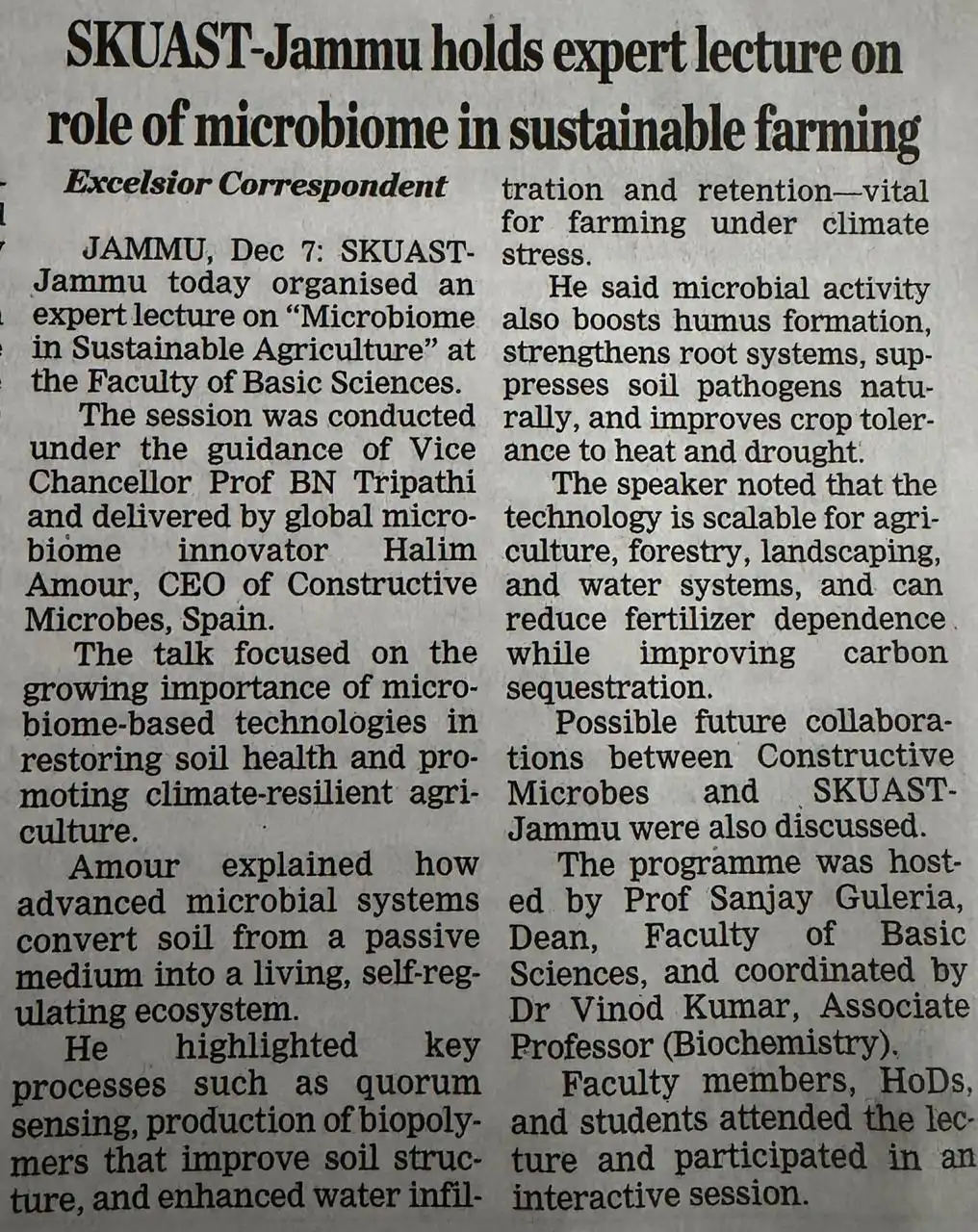
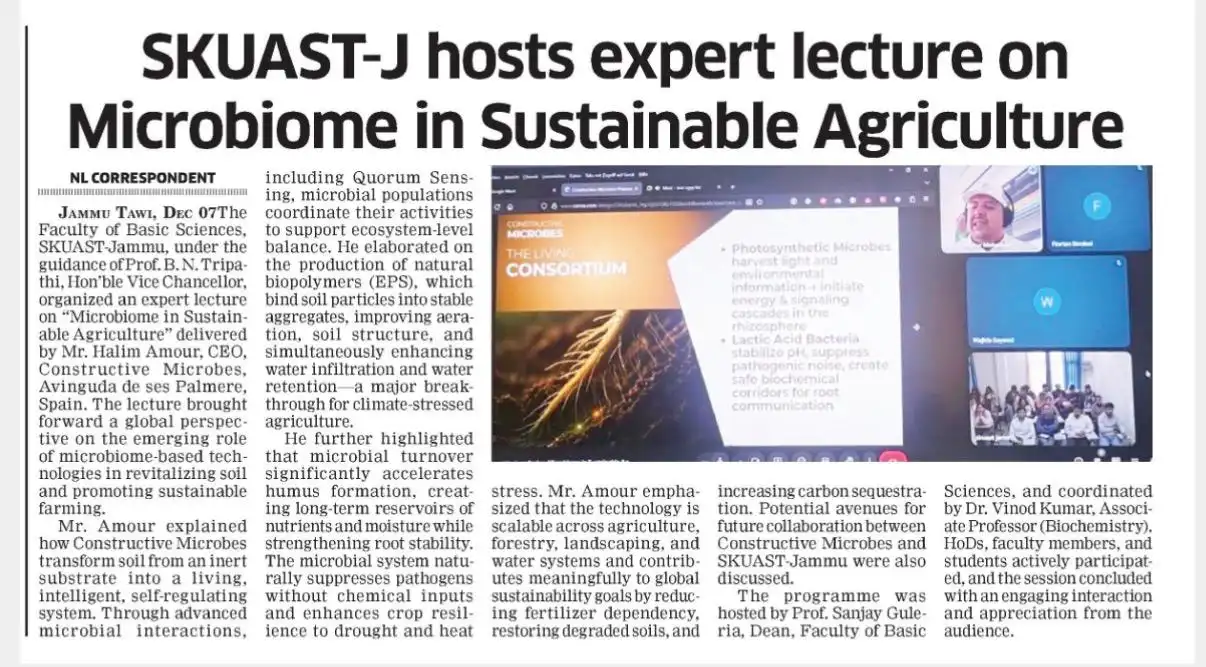
Two regional media outlets in Jammu reported on the expert lecture and highlighted the links between microbiomes, soil structure, humus formation and climate-resilient agriculture.
Daily Excelsior described how advanced microbial systems can help transform soils from a passive medium into a living, self-regulating ecosystem and underlined the importance of quorum sensing, biopolymers and microbial activity for water infiltration, water retention and soil health.
The newspaper The Northlines published another article under the headline “SKUAST-J hosts expert lecture on Microbiome in Sustainable Agriculture”, portraying Halim Amour Mohamed as an international guest speaker and emphasising how microbiome-based technologies can support humus formation, water infiltration and the resilience of crops under climate stress.
For us at Constructive Microbes, this coverage is external confirmation that the topic of the soil microbiome in sustainable agriculture has firmly entered academic and public discourse – particularly in regions that are already strongly affected by climate stress today.
From expert lecture to constructive research collaboration
After the lecture, the leadership of SKUAST-Jammu – including Hon’ble Vice Chancellor Prof. B. N. Tripathi and Prof. Sanjay Guleria, Dean of the Faculty of Basic Sciences – thanked Halim Amour Mohamed for his contribution and signalled their interest in deepening the collaboration.
Together with the faculty, further steps towards a constructive research cooperation are now being explored. The central questions include:
Under the site conditions of Jammu & Kashmir, how do microbial consortia influence
soil structure,
water infiltration and water storage,
humus dynamics,
and the resilience of crops under climate and water stress?
How can students, using simple, scientifically grounded field methods, learn to observe soil functions and microbial effects themselves?
The aim is to link the university’s teaching and research activities with practical experience from different climate regions and thereby create a robust foundation for microbiome-supported soil regeneration. Concrete field trials, teaching modules and joint publications will be developed step by step and scientifically evaluated by the university.
Why this collaboration matters for the future of soils
The invitation to Jammu, the expert lecture “Microbiome in Sustainable Agriculture – The Homeostasis Code” and the positive response from the university and the media show that
the soil microbiome,
microbial consortia and
climate-resilient, sustainable agriculture
are no longer fringe topics, but are moving to the centre of agronomic debate.
Research findings on soil microorganisms, EPS and microbial necromass confirm that these are key levers for soil regeneration, water management and carbon storage.
Constructive Microbes sees this development as a clear mandate to continue along this path:to view microbes not merely as a product, but as partners in a living soil system – and to work together with scientific institutions such as SKUAST-Jammu to develop solutions that restore soils to their full functioning capacity worldwide.
References
Global soil and land degradation
FAO: Global Soil Partnership – Some 33 percent of soil is moderately to highly degraded (2014, 2015, various summaries).
FAO: Healthy soils are our climate champions (2022).
Land degradation in India
The Economic Times: Soil degradation on 30 pc of India’s land poses threat to agriculture (2024).
India Water Portal / ISRO data: India’s target to combat land degradation and desertification (2019).
Down To Earth: Land degradation in India hurts farmers and forest dwellers the most (2021).
SKUAST-Jammu and faculties
SKUAST-Jammu – official website, overview of faculties:
SKUAST-Jammu – Faculty of Basic Sciences (profile and mandate).
Media reports on the expert lecture
Daily Excelsior: SKUAST-Jammu holds expert lecture on role of microbiome in sustainable farming (8 December 2025).
SKUAST Jammu / social media post about the event and the Dean, Faculty of Basic Sciences.
The Northlines (via PressReader): SKUAST-J hosts expert lecture on Microbiome in Sustainable Agriculture (8 December 2025).
Scientific sources on the soil microbiome, EPS and humus
Iqbal S. et al. (2025): Microbial communities and their transformative role in soil ecosystems – overview of soil microbiome functions for soil fertility, stress buffering and physical soil properties.
Chen Q. et al. (2024): Soil Microorganisms: Their Role in Enhancing Crop Productivity and Soil Health – review on EPS, aggregate formation, the root environment and water-holding capacity.
Guhra T. et al. (2022): Pathways of biogenically excreted organic matter into soil aggregates and soil structure – role of microbial exudates and necromass for aggregate stability and carbon binding.
Coban O. et al. (2022): Soil microbiota as game-changers in restoration of degraded soils – summary of how soil microorganisms contribute to the restoration of degraded soils and can improve physical soil properties.
Policy brief / study: The soil microbiome – its role in sustainable soil management (IEEP, 2023).
Comments